

Lawsuits for Alberta’s latest boondoggle are already starting to pay out, and the first disclosed payment—a settlement with one of the five companies who were demanding $16 billion in damages—already has Alberta twice as deep in the hole as 2022’s “Turkish Tylenol” debacle.
The decision that left Alberta on the hook to a pack of coal companies was made in 2020, but this story really begins in 2012, when Stephen Harper’s Conservative federal government enacted regulations meant to wean Canada off of coal-fired electricity.
Even fossil fuel expansionists could see that coal-generated electricity just didn’t fit a modern and carbon-constrained economy. According to the feds, fully 11 per cent of Canada’s greenhouse gas emissions in 2012 were coming from coal-fired power plants. Thanks to Harper’s regulations, coal power was already on the way out when the Alberta NDP won power here in 2015.
But that’s not to say the Alberta NDP didn’t turn up the dial. Harper’s plan was for the last coal power plants in Canada to close up around 2060. Rachel Notley’s NDP government chose to accelerate the coal phase-out to 2030, and that’s when coal really started to become a culture war issue here in Alberta.
There weren’t that many jobs at the coal plants or the mines that fed them, but they were jobs that paid very well, and jobs that tended to be centralized in a few specific communities. Those towns were hit hard economically by the phase-out. While it really was a good idea to stop burning coal—it’s not just bad for the environment, but also sends a lot of people with asthma and other pulmonary conditions to the hospital—it’s no surprise that the communities that bore the economic cost of it ended up deeply resentful.
By the end of the Notley government, coal had moved out of the realm of technical policy and become yet another right-versus-left fight. The UCP invoked it deceptively. In 2019, the UCP campaigned on scrapping the NDP phase-out plan and returning to the Harper schedule. They won power and just left the coal phase-out mostly as is.
Economic realities by that point had simply killed coal power; the math just didn’t work out. But the symbol’s power persisted, so the Kenney government engaged with it in a different way: supporting continued coal production, not thermal coal for generating electricity, but metallurgical coal to export for making steel.
The pivot was encouraged by vigorous lobbying. In January, Brett McKay reported for the Tyee that as early as 2017, coal lobbyists were starting to push for the Grassy Mountain coal mine. The Kenney government and the coal lobby got along intimately. McKay notes that the lobby fielded at least 14 former government insiders in the effort, including “past energy and environment ministers; an Alberta Energy Regulator executive; policy advisers; and various senior staff from UCP, NDP, Wildrose and Progressive Conservative caucuses.”
Mining metallurgical coal in other parts of the province wasn’t going to bring jobs back to the communities that had relied on mining thermal coal, but it was still a way to invoke coal as a culture-war symbol while making foreign billionaires—like Gina Rinehart of Northback Mining—some money, and that was good enough.
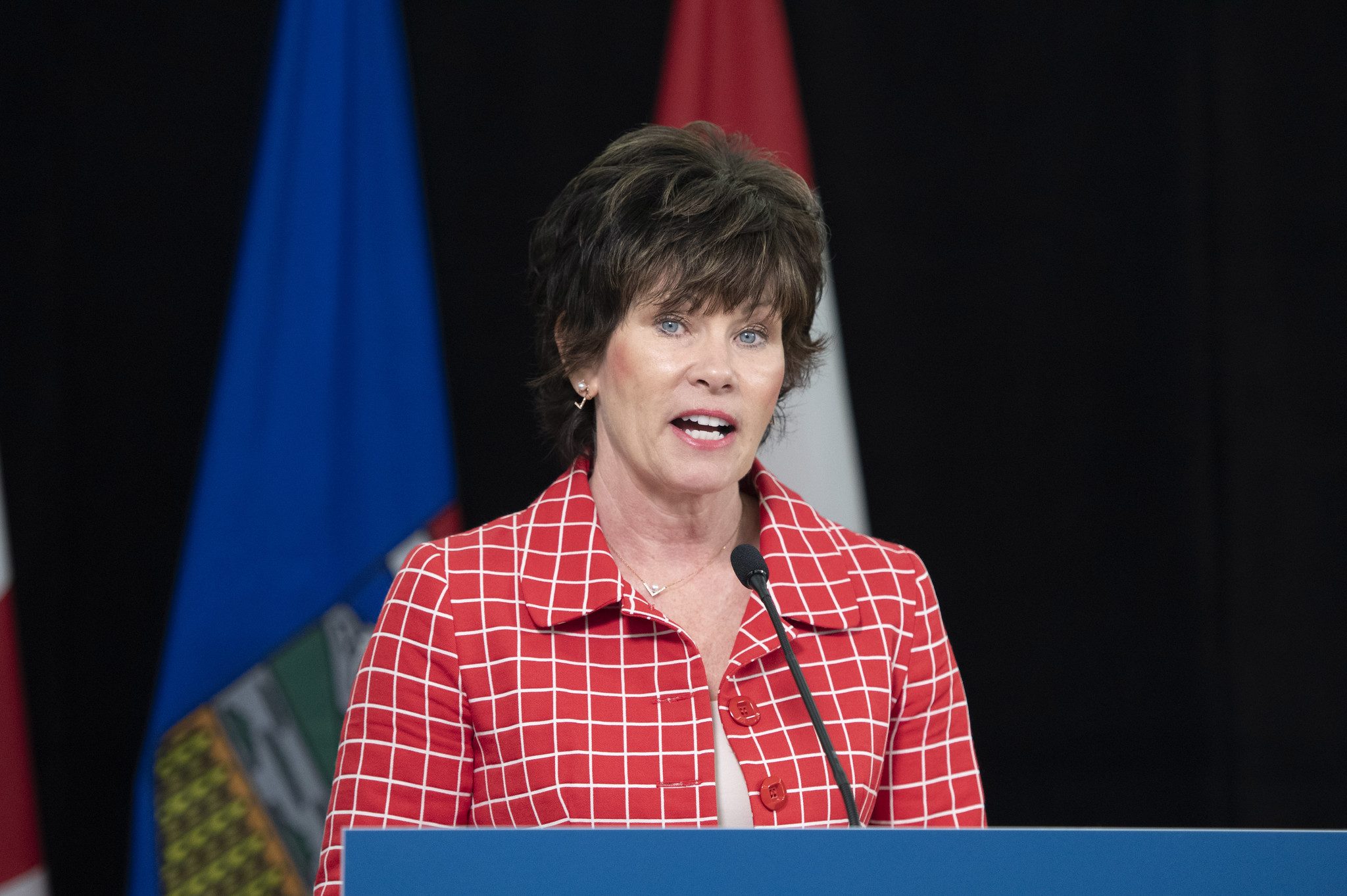 Energy Minister Sonya Savage announces new UCP energy policies in 2022. From the Government of Alberta flickr
In 2020, Energy Minister Sonya Savage—herself a former fossil fuel lobbyist—abruptly rescinded coal regulations from 1976 that had prevented coal mining in the Eastern Slopes of the Rockies.
The lobbyists loved it but many locals didn’t. Savage’s decision spurred a protest coalition that brought together environmentalists, conservationists, ranchers and farmers who objected to the removal of mountaintops and water pollution that coal mining entails. Corb Lund, a country star from Taber, became one of its leading spokespeople. And while the Kenney government brushed them off at first, Lund and the anti-coal campaign kept up so much pressure that a year later Savage reversed her decision.
But by then, Alberta’s vulnerable bits were already in the proverbial vice. By opening the Eastern Slopes of the Rocky Mountains up to coal projects, Savage and the UCP had invited coal companies around the world to invest in and commit to massive projects, and pulling the rug back out from under them a year later left the province vulnerable to legal action.
Cabin Ridge Holdings, Atrum Coal and its subsidiary Elan Coal, Black Eagle Mining Corporation, and Montem Resources quickly filed suit for over $10 billion—and then sought damages that have since ballooned from $10 billion to $16 billion.
And those lawsuits are already paying out. This week, $137 million went out the door to Atrum, with another $6 million coming the company’s way once it completes reclamation work on the site of its proposed project. This one settlement already costs double what the Smith government blew on the infamous “Turkish Tylenol” back in 2020.
Earlier in July, the government announced it had reached settlements with Atrum and Evolve Power, now known as Montem Resources. The settlement sum with Montem has yet to be publicly disclosed.
Savage and the last UCP government risked hundreds of millions of public funds on a culture-war stunt as dicey as Smith’s Turkish Tylenol screw-up. But unlike the Tylenol mess, Alberta may be paying the bill on coal for years to come.
From the Report
-
On the podcast this week, we spoke with Opposition MLA and former health minister Sarah Hoffman about Alberta’s ongoing measles crisis. It’s bad!
- Jeremy followed up on the Edmonton Police Service’s 2015 steroid trafficking scandal, in which current interim chief Warren Driechel was implicated. Documents acquired by defense lawyer Tom Engel via a freedom of information request show that as many as 53 officers were implicated in the Edmonton police steroid trafficking ring in 2015. So many members of the tactical unit were involved that the EPS had to temporarily eliminate one of its three teams.
Sundries
-
Right-wing operatives have been stalking Globe and Mail journalist Carrie Tait, one of the leading reporters covering the Alberta health procurement scandal. David Wallace, who some may recall from the release of the ‘Klondike Papers’ in 2022, is implicated, as is an anonymous Twitter account called “The Brokedown,” not to be confused with Nate Pike’s The Breakdown.
-
The ongoing measles outbreak is leading to restrictions at health-care facilities, with the Cross Cancer Institute in Edmonton, the Arthur J.E. Child Cancer Centre in Calgary and the Jack Ady Cancer Centre in Lethbridge ordered to implement COVID-like visitor restrictions to keep patients safe.
-
The Better Edmonton municipal party in Edmonton and its leader Tim Cartmell must be sweating this week, as yet another prominent right-leaning candidate has announced they will be running for mayor. Former councilor and Berlin Communications owner Michael Walters has joined the race, which now includes Cartmell, Walters, present councillor Andrew Knack, and noted interview-faker and cocaine-possessor Rahim Jaffer.
-
Danielle Smith served as the marshal for the Medicine Hat Exhibition and Stampede parade this week, leading the local Pride club to withdraw its participation in the parade to protest her government’s anti-trans policies.
-
After a stern letter from the UCP told them no, they couldn’t use the old Progressive Conservative Party brand because the UCP retains the rights to it, UCP expatriates Peter Guthrie and Scott Sinclair have announced they’ll instead be reviving the Alberta Party and rebranding it as the PCs.
- Separatist leader Dennis Modry claims that the Trump administration proposed giving Alberta a $500 million loan to get us to become the 51st state. Buddy, that doesn’t even pay our legal bills!
This is the online version of the Progress Report email newsletter. Don't depend on some social media or search engine algorithm to find this content in the future. Sign up to get updates on the most important local political issues in your inbox every week. The Progress Report is funded by readers like you: if you'd like to see more, please consider becoming a monthly patron.