

In March 2015, two Edmonton Police Service (EPS) officers—Sgt. Greg Lewis and Const. Darren French—were charged with trafficking illegal steroids within the police force and suspended without pay.
The Edmonton Sun reported that six officers were caught purchasing anabolic steroids from Lewis and French between 2005 and 2013, leading Chief Rod Knecht to confidently state that the scandal “was confined to a small group of individuals and their associates.”
One of the officers identified by the Alberta Serious Incident Response Team (ASIRT) was Const. Warren Driechel, who was then a member of the Edmonton Drug and Gang Enforcement Unit.
Driechel thereafter continued to rise through the ranks to deputy chief. Today he is one of two officers the Edmonton Police Commission appointed to concurrently serve as interim chief in February 2025, and reportedly has his eyes on the full-time job.
Documents that Edmonton criminal defence lawyer Tom Engel requested through FOIP in November 2015, but didn’t receive until June 2024, provide a clearer picture of the scope and impact of the steroids scandal.
Not long after Lewis’s and French’s indictments, it became increasingly evident that the six officers ASIRT initially identified as having purchased steroids from them were just a fraction of those involved. As more officers began coming forward, Chief Knecht praised their “integrity and fortitude.”
By June 2015, after Const. Kevin Yaremchuck pled guilty at a disciplinary hearing to lying to investigators about his steroid usage, the Sun reported that there’s “a growing list of at least 30 officers recently found to have used steroids in the last several years.”
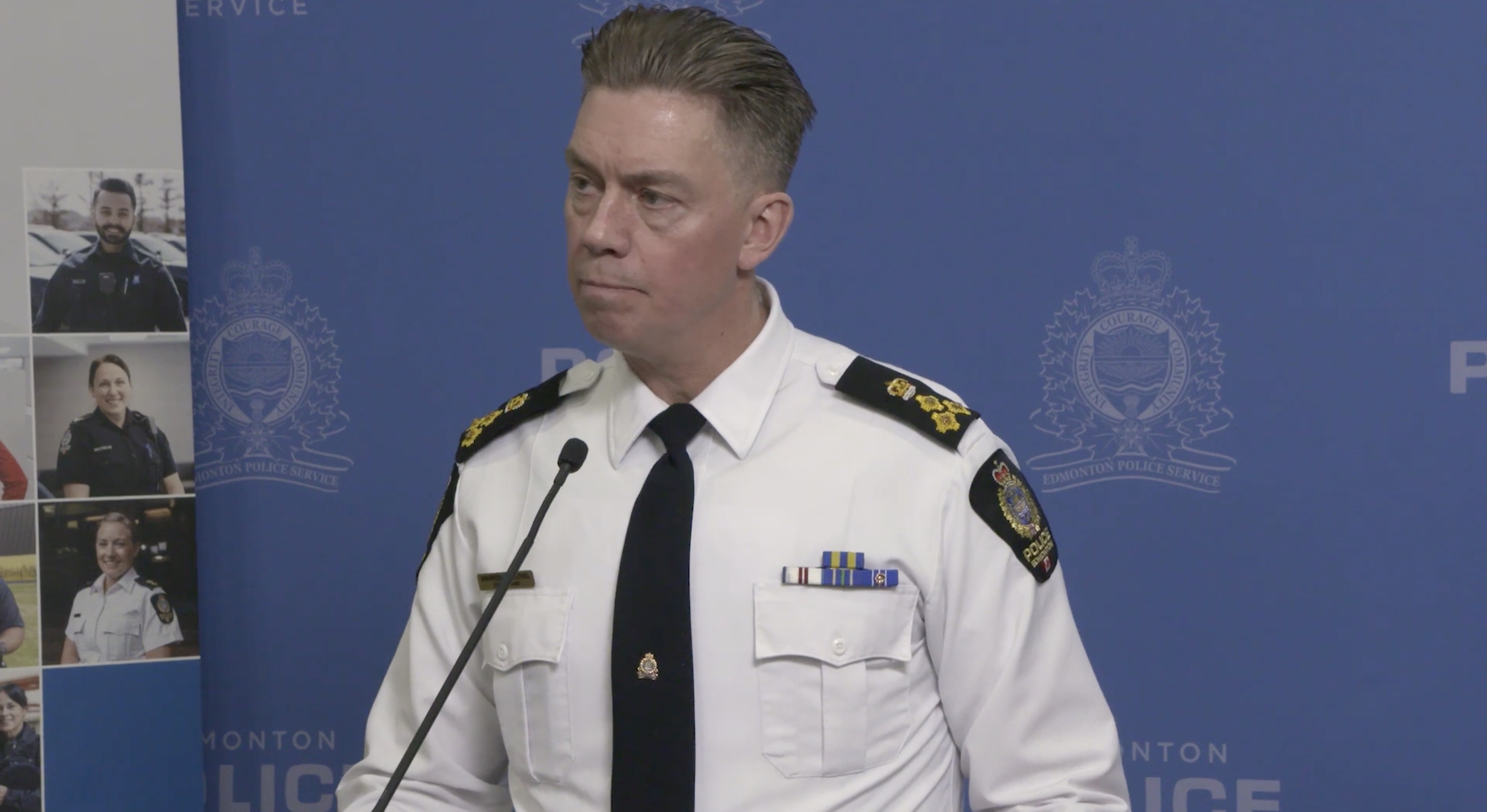
At a February news conference announcing he was one of two officers chosen as Edmonton Police Service's interim chief, Warren Driechel was asked about having been identified as an officer who purchased anabolic steroids while he was a member of the Gang and Drug Enforcement Unit. (Screenshot/YouTube)
Not trusting the police’s official account of the steroid scandal, Engel requested the names of every officer identified as having used illegal steroids over the previous decade and, based on a confidential tip he received, any correspondence regarding the merging of tactical units as a result of the scandal.
“I knew there were way, way more cops involved in this than disclosed by the EPS,” Engel told the Progress Report.
The EPS refused to release any information that wasn’t available from the disciplinary hearings of Const. Yaremchuk and another officer who pled guilty to lying about steroid usage, Sgt. Adam Toma.
More than eight years after the initial request, the Office of the Information and Privacy Commissioner ordered the EPS to release the list of officers but redact the names of those who were never identified in media reports and “to disclose additional information that did not relate to an identifiable individual.”
According to the FOIP documents, the use of steroids was so widespread among the EPS Tactical Section that the unit had to collapse its three units into two for six months.
Referring to “recent manpower issues,” a March 11, 2015 memo from Staff Sgt. Trevor Hermanutz to EPS inspectors says that “we have found it necessary to merge our teams and form two larger teams which will enable us to provide the best possible coverage/service for the next few months.”
As a result of this consolidation, a tactical team was only available on call on Sundays and Mondays.
This had deadly consequences for Const. Daniel Woodall, who was shot to death by white supremacist Norm Raddatz in June 2015 while Woodall and two other officers were serving an arrest warrant for antisemitic harassment.
According to the fatality inquiry into Woodhall’s killing, “EPS members discussed having the Tactical Unit attend as well but no formal request was made,” because the officers “were advised that Tactical did not ordinarily work on Mondays.”
The inquiry report, written by Judge Greg Lepp, doesn’t elaborate on why Tactical wasn’t working on Mondays.
53 officers investigated
The documents include a “Steroids Summary” which identifies the EPS as having opened 53 files in relation to the steroids scandal, 40 of which had been closed.
“Jeez, that’s a lot,” NorQuest College Justice Program chair Dan Jones, who was an EPS inspector at the time of the scandal, told the Progress Report. “I had no idea there were that many.”
The summary is undated, but it had to have been from before Lewis and French were charged in March 2015, since it refers to three files that have been “held in abeyance until conclusion of the ASIRT investigation.”
The only officers listed as having admitted to using illegal steroids whose names aren’t redacted are Yaremchuck, Toma, and Sgt. Steven Maertens-Poole. Maertens-Poole was identified in court as having purchased anabolic steroids from French in 2005 when they were both members of the Tactical Section.
Of the 40 files that were completed, just 12 resulted in discipline, with only Toma and Yaremchuck going to disciplinary hearings.
For the remaining 10 officers, disciplinary measures were conducted under Police Service Regulation section 19, which deals with “minor contraventions” that don’t require a public hearing. The document identifies measures ranging from a reprimand to 60 hours suspension.
This is concerning from the perspective of a criminal defence lawyer, said Engel.
“If you're being prosecuted, the accused or the defence counsel should be aware of any misconduct in a police officer's background, and this would not be disclosed by the police to the Crown,” he explained.
The other 30 closed files are categorized as NRP, meaning no reasonable prospect of finding them guilty in a disciplinary hearing; Loss of Jurisdiction, meaning the officer quit before they could be disciplined; Changed to Wi, meaning the officer agreed to cooperate as a witness to another officer’s disciplinary hearing; 43(11), referring to the section of the Police Act that requires an investigation must occur within a year of alleged misconduct being discovered; and Awaiting Disposition, referring to the chief having yet to make a decision on disciplining those officers.
“Even though all that time went by, many of these police officers are still with the police service,” said Engel. “I think it's important to know what they are in charge of. What positions do they hold?”
Where are they now?
According to his LinkedIn account, Maertens-Poole, who resides in St. Albert, remains employed as an EPS sergeant.
While Toma was demoted from sergeant to constable for two years and lost $20,000 in pay, by 2020 Toma had become an acting staff sergeant.
Yaremchuk was demoted to a fourth-year constable, losing $30,000 in pay, and he does not appear to be employed as a cop today.
After resigning to avoid a disciplinary hearing, French pled guilty to two counts of trafficking in a controlled substance and was sentenced in 2016 to a $1,500 fine, probation and 240 hours community service.
Lewis pled guilty to two trafficking counts in 2018, receiving probation and a $7,000 fine. Unlike French, Lewis faced a disciplinary hearing, which led to his firing in December 2022—after nearly eight years of unpaid leave.
In addition to the drug trafficking, the ASIRT investigation found that he used his police phone and email account to send sexually explicit content that “demonstrated a sexist, demeaning and inappropriate attitude towards women including (Lewis’) fellow officers,” said presiding officer Fred Kamins, a retired RCMP superintendent.
When he was named interim chief in February, Warren Driechel was asked to reflect on his role in the scandal.
“I knew that I’d have to one day confront this and talk about this,” said Driechel. “I have agonized over this every day of my career since that happened.”
He added that he was “going through some challenging times” when he was implicated in the scandal.
“I would never talk about them in a group or public (setting), but it was something that I did and I admitted to. I learned from it, and hopefully will try to move past it,” Driechel said.
Driechel’s rise through the EPS ranks shows why this story is still relevant so many years later, said Engel, who questions the sincerity of Driechel’s apology.
“The only reason he's talking publicly about it is because he knew it was going to come out when he was running for interim chief,” said Engel. “He had all those years to publicly apologize. He didn't do it.”
‘Losing is not an option’
Jones of NorQuest College said the widespread use of steroids among EPS officers is an issue of policing culture, one which is by no means limited to Edmonton cops.
In 2007, six New York Police Department officers were found to have purchased steroids from a Brooklyn pharmacy that was selling them illicitly. In 2009, 11 Boston cops were suspended for using steroids.
Steroid usage and the aggressive behaviour associated with it is the product of a “warrior mindset” that runs deep in policing circles, Jones explained, in which “we train people that everyone’s a threat.”
“Sometimes you get these individuals that think that they need that advantage for the street work,” he explained.
Jones recalled seeing posters in the police gym when he first started as an EPS officer that read, Losing is not an option, and others depicting prisoners in Correctional Service Canada jumpsuits working out, suggesting that “if they're doing this, you need to be doing this.”
Jones added that it’s a similar mentality of winning at all costs that one sees in professional sports, which has of course had its own share of steroids scandals.
Because the steroid scandal was ultimately an issue of policing culture, Jones believes that it “should have been handled extremely differently.”
“To me, the steroid scandal was something that shouldn't have been about discipline, and it shouldn't have been about some people losing their careers and other people moving up eventually,” he said.
“I think it should have been about health, and it should have been looked at differently.”
Jones said he didn’t witness any significant cultural changes resulting from the scandal, “because it wasn’t handled like that.”
“We need to change the way we train in policing and officer safety is absolutely important, but so is understanding the justice mind, understanding trauma and being trauma aware,” he said. “Compassion needs to be at the top of the list. Not just compassion externally, but compassion internally.”