

There’s no political event in Alberta more quintessential than Stampede, and I don’t mean that as a compliment.
When the American vaudevillian entertainer Guy Weadick first cooked the idea up in 1912, Alberta’s ranching industry was already largely out the door. As several essays explain in Lewis Thomas’s Rancher’s Legacy, advances in mechanized farming coupled with a brutal 1906-1907 winter had already pushed ranching into steep decline, and agricultural land in the province was increasingly being used for wheat, not cattle.
Not one to let reality get in the way of a good show, Weadick canvassed the Calgary business community anyway. Actual jobs on ranches may have dried up, but the businessmen who had cashed in while ranching was profitable were still sitting on a lot of capital. Weadick successfully talked a number of them into using some of it to do a little myth-making about their old industry.
The whole thing has a whiff of I ♡ Oil And Gas about it. We love to pretend hollowed-out industries in decline are the soul of the province, don’t we?
Thomas argues that even all the way back in 1912, the Stampede culture was fake—since the ranch barons were largely British and eastern Canadian, the local ranching culture drew much more from an English country estate ethos than the American Wild West. But let’s put a pin in any talk about Stampede coming from the Laurentian elites before someone shows up at my office with a six-shooter.
More than a century later, Stampede persists as the most spotlit retail politics event in Alberta every year. It’s the season when every media outlet runs puff pieces about politicians flipping pancakes, as though getting a brief hello from a party leader as they work the griddle is real political engagement.
The real politics isn’t being done in the breakfast lines but in the hospitality suites, where Calgary’s corporate elite indulge in the sort of old-boy networking that dominated Alberta politics for decades and has led, I’m sure, more than a few politicians into problems with alcohol.
It was heartening to read Naheed Nenshi claim that he’s telling his caucus to eschew the hospitality suites and stick to church breakfasts, which is in line with a push to break out of the old-boy politics box that began for the NDP under Notley, but I still can’t arrive at any conclusion other than our ritual annual slaughter of chuck wagon racing horses is a bit perverse.
It’s panel time again!
Speaking of time, flat circles, and perversity—Danielle Smith launched her latest panel late last month.
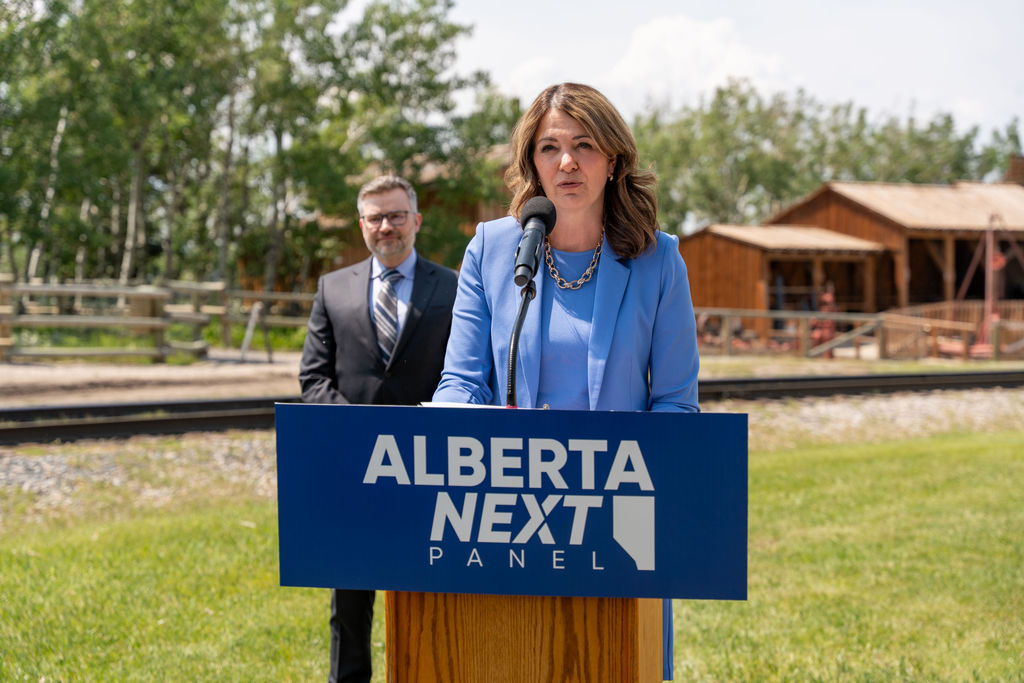
Danielle Smith speaks at the Alberta Next launch event on June 24. Image from the Government of Alberta Newsroom Flickr
This one is called the Alberta Next panel and it’s very nakedly a repeat of the UCP’s Fair Deal panel from 2021. You’ll recognize a number of returning characters from Smith’s other panels—plenty of UCP MLAs, Chamber of Commerce types, ghoulish petro-populist agitator Michael Binnion and even that acupuncturist Benny Xu that the UCP keeps appointing to things.
Just as in 2021, the aim of the project appears to be to rile up separatists just enough for Smith to use them as a cudgel without getting bonked herself. The panel will be hosting public engagement events across the province which will push the same unpopular proposals they’ve been pushing for years—pulling us out of CPP, establishing an Alberta police force, and mucking with the constitution.
An evolution of the UCP game is that this panel’s surveys are designed to block the embarrassing flood of disagreements and complaints we usually find in the results. This time around, before you take the survey you’re shown a video arguing for the government’s preferred positions—and then once you get in there, it’s all multiple choice and none of the choices let you disagree with the government. Great stuff.
While in most respects this panel is just another in a long line of these things, one detail caught my eye. Relatively (formerly?) respectable Calgary academic Trevor Tombe is lending his name to this one.
Tombe told The Tyee’s Graham Thomson that he doesn’t see anything “that’s unambiguously good or bad” in the Alberta Next proposals, adding in true economist fashion that “the information around what the benefits and costs of different ideas are” will be “helpful information for Albertans to evaluate things.”
“I’ll certainly be steering clear of the politics,” he said before cautioning, “Maybe that’s naive for me to think that that’s possible.”
Recently from the Report
-
Following up on a file he’s been working for quite some time, Jeremy reports on how Shoppers Drug Mart is being embedded into Alberta’s mental health and addictions system, a privatization effort that front-line workers allege is coming at the cost of patient care.
- Edmonton councillor Michael Janz has been a popular character with our audience for his calls for police accountability and funding restraint in Edmonton—though he has moderated those positions of late—and so we were sure to catch his campaign launch and then to get Janz on the podcast for a more substantive conversation.
A quick update on us
We’re very grateful for the support that readers like you (and maybe including you!) pitched into our fundraising appeals over the last two weeks. As you may have read online or in the last newsletter, we had a bit of a human resources disaster over the summer that left us deep in deficit.
I’m happy to report that we are mostly but not entirely out of the hole. The response was very good, so much that I’m still not done writing thank-you notes to everyone.
Jeremy and I keep very modest salaries and run a pretty tight ship here so it doesn’t take much to keep this vessel afloat, usually. That being said, we’re still about $3,000 shy of the target we needed to hit. If I somehow missed you with our recent fundraising pitches and you’d like to contribute, please visit theprogressreport.ca/patrons where we would be thankful for anything. If you would prefer to donate through an e-transfer or by cheque, let me know by email.
Sundries
-
Government data shows that there were more opioid poisoning deaths in March in Edmonton this year than in any other month on record—yet another data point condemning the UCP’s recovery-first drug policies.
-
Newly minted Minister of Municipal Affairs and archetypal La Crêtian Dan Williams says Alberta municipalities under his watch won’t have any more of that ‘DEI’ (that is, policies to prevent people from minority communities being excluded) and better “keep away from wokeness.”
-
Over on his personal blog Jeremy recounts his visit to the big separatist rally on Canada Day. Sounds terrible! We recorded a new pod episode to get into this in more depth last Friday, so keep an eye on your podcast feed for that later this week.
-
Council in Lethbridge will soon be considering pumping another $1.4 million into the Lethbridge police budget over the next two years in order to pay for body cams. About $410,000 is expected to be covered by grants from the province. The UCP mandated in 2023 that all police forces in the province adopt body cams by the end of next year, though it’s still an open question whether body cams actually reduce police violence.
-
The Alberta Prosperity Project—one of the two present standard-bearers of Alberta separatism alongside the new Alberta Republican Party—has released a fiscal plan claiming that an independent Alberta could run a billion dollar surplus on the back of gold, oil, Bitcoin, and barring immigrants who have had a COVID vaccine.
-
Council in Medicine Hat is considering improving the city’s active transportation network and so, predictably, Medicine Hat council chambers were packed on Monday with residents complaining about “15-minute cities” and decrying what they call a lack of engagement. Opposition to commuter cycling is a culture war issue for the conservative base province-wide, so expect opposition against it to intensify everywhere as we approach the next municipal elections.
- In Edmonton, council has been tied up with two separate contentious issues: one, whether to give Darryl Katz and the Oilers Entertainment Group even more community revitalization levy (CRL) money to expand the Ice District, and the other a debate over how much infill development the city should allow. Despite some campaigning against it by Michael Janz, council elected to give the Oilers their top-up. Infill was mostly kicked down the road to the election, but a motion from Mayor Amarjeet Sohi to keep allowing 8-unit mid-block projects narrowly avoided defeat due to Tim Cartmell missing the vote.
This is the online version of the Progress Report email newsletter. Don't depend on some social media or search engine algorithm to find this content in the future. Sign up to get updates on the most important local political issues in your inbox every week.