

At the beginning of this year, MacEwan University began implementing sweeping surveillance efforts targeting anti-genocide student demonstrators who were placed under investigation for what appears to be their political speech, according to documents obtained through FOIP.
This heightened surveillance directly involved top MacEwan executives and came immediately after the university fired its security director.
“It’s unsettling because you, as a student, cannot even feel safe on your own campus,” said Nour Salhi, one of the students targeted for surveillance. “You’re walking the halls with a sense of paranoia because you don’t know who’s involved—and that’s exactly what they want. It’s very much a clear attempt to intimidate students, to scare them.”
After reviewing the FOIP documents, Salhi and two other MacEwan students—Eve Aboualy and Abraar Alsilwadi—described MacEwan’s actions as a form of psychological warfare. “It’s like they want us to feel hopeless and powerless,” Alsilwadi said.
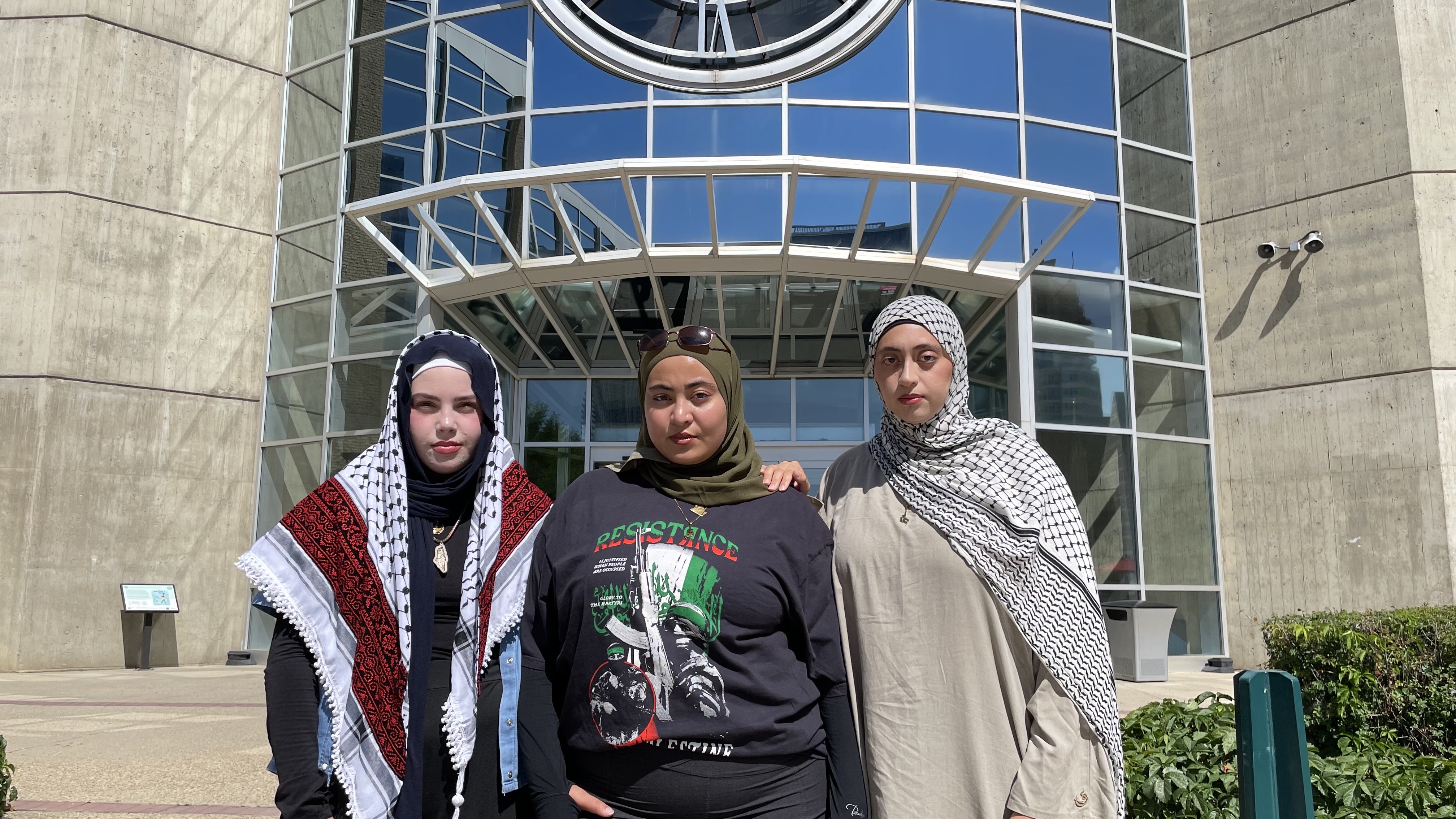
MacEwan students Abraar Alsilwadi, Nour Salhi and Eve Aboualy were investigated and surveilled by their university for their anti-genocide activism. (Credit: Submitted)
Aboualy thinks MacEwan’s surveillance tactics are part of a targeted removal strategy. “They’re spending a lot of time accumulating so much data on students, pro-Palestinian students on campus, so they can eventually just remove them completely.”
The Progress Report previously reported that Aboualy was prohibited from attending her graduation ceremony. This came after MacEwan investigated her, Salhi and Alsilwadi for multiple misconduct allegations, finding them guilty of causing a disruption and barring them from all “non-mandatory university activities.”
MacEwan delayed sending its decision letters to the trio until just days before graduation.
Additional documents obtained by the Progress Report reveal a covert disciplinary process, expanded procurement of surveillance equipment, a high-level command and control of the school’s surveillance and security operations, and a highly secretive FOIP release procedure.
The students disciplined are former executives of the Palestine Students Association, a student group that has since been suspended by the Student Association of MacEwan University (SAMU), which cited “repeated and serious violations of SAMU’s Student Groups Handbook and Student Groups Code of Conduct.”
Students under siege
MacEwan University students have organized at least 10 campus demonstrations since October 2023, responding to what a growing international consensus of human rights organizations and genocide scholars describes as Israel’s genocide of Palestinians in Gaza. These demonstrations have included marches, rallies, leaflet drops, learning sessions and coordinated walkouts.
Students also directly challenged MacEwan’s ties to Israel by demonstrating against the university’s procurement of Ex Libris, an Israeli-made library database system, which has continued throughout the genocide.
FOIP documents reveal MacEwan’s increased use of surveillance, extensive information sharing with city police and the implementation of action plans to address student “disruptions.” One of these plans resulted in the school calling the police on its students in March 2025.
Video and photos also obtained by the Progress Report reveal the direct involvement of C-suite executives in surveillance operations, representing a significant shift from previous school practices that began this year.
MacEwan students were among those forcibly removed by police during the clearing of the University of Alberta Palestine encampment in May 2024. When asked about the police violence against its own students, MacEwan President Annette Trimbee offered only a generic statement about being “committed to protecting freedom of expression”. She said the university’s “utmost priority” was physical safety, but declined to condemn the police actions.
A 'clear violation' of Charter rights
MacEwan’s actions constitute a “clear violation” of constitutional protections, says James Turk, director of the Centre for Free Expression at Toronto Metropolitan University.
“They have a right to know the allegations made against them,” Turk said. “They have a right to be represented by a lawyer or colleague, and they have a right for the adjudication to be fair, transparent and conducted in a natural and just manner.”
Salhi, Aboualy and Alsilwadi each received letters from MacEwan University on January 23, 2025, notifying them that they were under investigation for intimidation, slander, harassment, defamation, and causing a disruption.
Turk pointed out that the Alberta Court of Appeal has previously ruled that universities must comply with the Charter in relation to restricting student expression, potentially giving these students grounds for a legal challenge. “Anything the university does to interfere, chill or limit those rights could be challenged in court, probably successfully,” Turk said.
The MacEwan letters did not indicate who had made the misconduct allegations against the students, nor how the school identified them.
“They sent a very general email with no description, no explanation,” Salhi said. “They tried to rush us into a meeting before we had a chance to access resources.”
“They couldn’t even tell us who we were defaming or intimidating,” Alsilwadi added.
According to the investigation notice, MacEwan hired former police officer Kevin Galvin to investigate the students. Galvin retired from the Edmonton Police to work for the Katz Group and lead its security program, in addition to operating a private investigation business.
Muhannad Ayyash, a professor at Mount Royal University and policy analyst for Al Shabaka, the Palestinian policy network, is not surprised. “This has been, by and large, the Canadian institutional response to those opposing genocide.”
“What you see here is a very predictable pattern that is not unique to MacEwan.”
Ayyash described MacEwan as “using repressive measures, such as harassment, intimidation, and the use of state authorities” to suppress and intimidate students who speak out on Palestine.
“They want to keep the movement small and say, ‘Oh, it’s just a few troublemakers we’ve taken care of,’” explained Ayyash, who is Palestinian-Canadian.
The fact that these protests were pro-Palestinian reinforces that this was politically motivated suppression of political speech and thus a “clear violation of the Charter,” said Turk.
On June 12, 2025, five months after the three students were told they were under investigation, MacEwan informed them that they were guilty. The judgment letters stated that CCTV footage, social media posts, and interviews with unnamed “witnesses and involved parties” were used as evidence to determine “on a balance of probabilities” that they violated school policies during their demonstration.
The letters stated that they did not fill out a required “Event Approval Form,” and claimed that as a result of their unauthorized demonstration, one student feared for their safety while writing an exam, and Board of Governors members received security escorts to their cars to protect their safety.
Ayyash said these documents demonstrate how systemic anti-Palestinian racism “is deeply rooted in Canadian institutions.”
Canada has always supported the Israeli settler colonial project and the further colonization of Palestine, he added. The way Canadian academic institutions act assists in the suppression of Palestinian narratives.
“So, that’s the role that MacEwan is playing,” Ayyash said. “It’s allowing that project to continue.”
Canadian universities have dismissed faculty members for expressing criticism of Israel and advocating for Palestinian rights. UBC terminated an instructor, and the University of Alberta dismissed the head of its Sexual Assault Centre.
Ayyash said he’s not surprised that the school chose to heavily censor and redact the documents. “Senior executives’ number one priority is not academic freedom, justice, or decolonization—it’s their reputation.”
Heightened surveillance
As Galvin, the former cop, started his investigation into the students, documents reveal that the school also began acquiring more surveillance equipment, specifically in response to pro-Palestinian protests.
Alongside the 300+ CCTV cameras already installed across the downtown campus, MacEwan purchased an unknown number of additional cameras. The procurement documents were heavily redacted, hiding the quantities, costs, and the requester’s name.
On February 19, a MacEwan official, whose name has been redacted, announced in an email that the additional “ad hoc” cameras would be the standard protocol for events considered “sensitive or of a protest nature.”
The “ad hoc camera” protocols were implemented after the previous MacEwan security director was dismissed in January, according to a source familiar with security operations. MacEwan has still not filled this vacancy.
A MacEwan security spokesperson told the Progress Report that security reports directly to MacEwan’s CFO.
The timing of the security director’s dismissal—just one week before the investigation began—was not coincidental, according to sources familiar with the situation. The removal cleared the way for direct executive control over security operations targeting student demonstrators.
Salhi noticed the escalation immediately. “After the firing of the director of security, there was a direct escalation in surveillance,” she recalled.
Some of the new cameras’ intended locations place them in areas frequented by the Board of Governors for their meetings, where students have demonstrated on numerous occasions.
On February 4, students demonstrated at the school’s library against its procurement of Ex Libris, during which MacEwan security first began using additional stand-alone “ad hoc” cameras to record them.
The Progress Report obtained additional video and photos from the demonstration showing MacEwan Provost Craig Monk and Maureen Powers-Lomas, Vice-President of Finance and Administration and CFO, involved in the “ad hoc” camera setup. They appeared to coordinate the camera setup and local activities with security and library staff.
According to a source familiar with MacEwan’s security operations, C-suite executives had never previously been involved in surveillance of student demonstrations. The direct involvement of Monk and Powers-Lomas represented a complete departure from established practices.
The Progress Report requested all photos and video from the February 4 demonstration, including the footage from the “ad hoc” cameras, from MacEwan. Citing FOIP Act sections 20(1)(k) and (m), in which disclosure could “facilitate the commission of an unlawful act or hamper the control of a crime,” or “harm property security and the integrity of the monitoring system,” the university withheld all video and photos in their entirety.
Ayyash said MacEwan is sending a message to students that there will be a cost to supporting Palestine. “These surveillance techniques and harassment techniques are meant to prevent others from joining the movement.”
For James Turk, the cameras themselves aren’t as constitutionally suspect as the university’s disciplinary actions against students exercising protected political expression.
“If the cameras were chilling expression or used in an over-the-top manner, that could be problematic,” he said. The court would need to balance the university’s legitimate concern for security with its respect for students’ right to freedom of expression.
Calling police to campus
On March 26, MacEwan and Board officials wrote a draft “action plan” to deal with potential “disruptions” for the next day’s Board of Governors meeting, documents show. MacEwan called city police to disperse student demonstrators during this board meeting.
Police threatened to give the students trespass notices and 24-hour bans, but only after a larger crowd of students arrived to witness and film the event did police back down.
A significant number of documents were withheld under FOIP Section 20(1) on the grounds that they contained information supplied by the Edmonton Police Service (EPS) to the school. EPS did not respond to repeated requests for comment.
“There looks like a lot of interaction with the police to try to get them involved and help the universities suppress these students and faculty,” Ayyash said.
“These documents show a coordinated effort to use surveillance, police interaction, and administrative procedures to marginalize Palestinian student voices.”
The trio has since filed their own FOIP requests, which they say show MacEwan always has police on standby.
In response to the Progress Report’s request for comment, MacEwan University did not address specific allegations about surveillance expansion, executive involvement in security operations, nor constitutional violations.
The university provided the Progress Report with an identical statement to the one it sent for a June 19 story about Aboualy being barred from her convocation ceremony.
The university, said spokesperson John Archer, “is committed to protecting and supporting freedom of expression,” but “is unable to discuss information about specific student discipline matters, including any sanctions which might be imposed following a finding of misconduct.”
'Refuse the silence that is being imposed on you'
Even though MacEwan banned Eve Aboualy from her graduation ceremony as punishment for her activism, she has zero regrets. “I would have done it again ten times harder.”
It was an emotional process, she said, because the school unfairly took away something that I spent six years working towards—her degree.
“My dream was to walk the stage and raise the flag,” she said. “I wanted to use that moment to honour the people of Gaza.”
She feels vindicated, and the documents confirm the students’ suspicions. She also saw some irony in the university’s extensive surveillance operations. “Part of me kind of likes that. Good, you’re seeing our messaging.”
“I’m curious to know who’s watching us,” added Aboualy.
Abraar Alsilwadi said she got into activism knowing the risks. “A revolution of any sort is for the long run. You put your foot into it; it’s not a short-term thing.”
“They would not be doing all of this if what we’re doing wasn’t working.”
Ayyash’s message to the students is: do not stop.
“Collective action—you cannot fight against these power structures on your own. Continue to speak up. You have truth and justice on your side,” he said.
“Be strategic, protect yourselves, arm yourself with knowledge. Refuse the silence that is being imposed on you.”
If you have any information for this story or information for another story, please contact us in confidence via email.