

Family and colleagues gathered at the University of Alberta’s Oborowsky Degner Seminar Hall on Wednesday to honour the legacy of Dr. George Hunter, a biochemist and professor who was abruptly ousted from the academy—according to his family, for his socialist and pacifist politics.
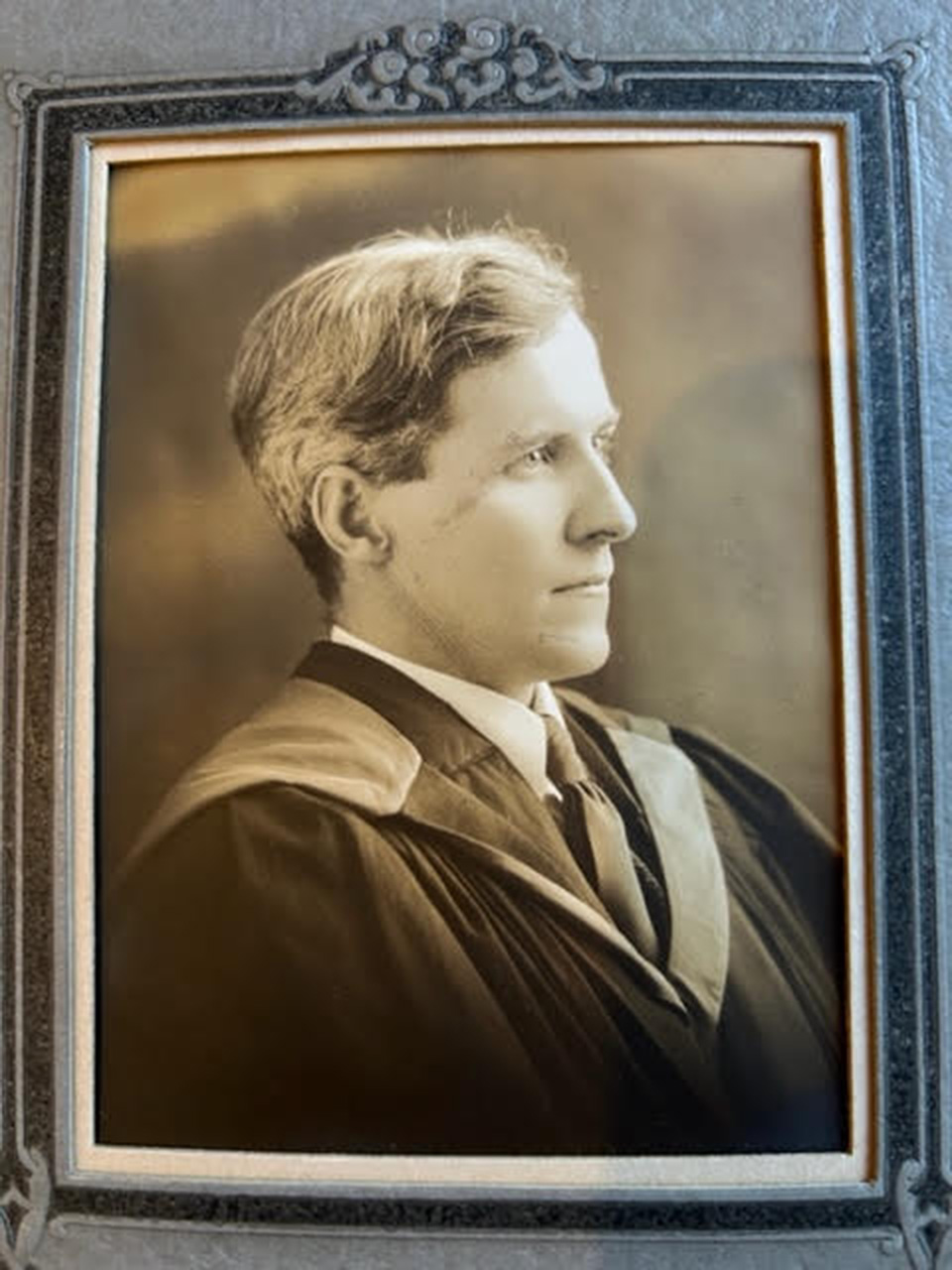 Dr. George Hunter, pictured here in his graduation photo.
Dr. Hunter was the University of Alberta’s chair of biochemistry from 1929 to 1949. A fellow of the Royal Society of Canada, Dr. Hunter’s work often focused on nutrition in mothers and children.
Born in 1894 in Ayrshire, Scotland, Dr. Hunter suffered from chronic pain throughout his life due to an untreated dislocation of his leg when he was a child. At the age of 10, he became an orphan.
Despite these challenges, Dr. Hunter studied at the University of Glasgow and thereafter moved to Canada in 1922, when he was twenty-five.
In an interview with the Report earlier this week, his grandchildren Janie and Robert Brown emphasised Dr. Hunter’s lifelong interest in politics, but noted that by today’s standards he would be fairly moderate.
“There’s a lot said about him being a communist,” said Janie. “I would call him an armchair socialist. Interested in Marx and Lenin, but he wasn’t about to start a revolution.”
“I think it was a kind of idealism. He believed students at the university had to open their minds to all kinds of political views, including the left.”
Robert Hunter told us that his grandfather “questioned capitalism because of what he saw as the very clear downsides and polarization of wealth. That was what he would share once a year at his year end lecture to his students.”
“We’ve read the lectures,” said Robert. “In my opinion, it was pretty innocuous stuff.”
 Dr. Hunter (right), at work with colleagues at the University of Alberta.
But that’s not to say Dr. Hunter was an apolitical humanist. A portrait of Vladimir Lenin hung on the wall at home. Quiet was expected in the Hunter home in the mornings, said Robert, so that Dr. Hunter could listen to the news from Moscow.
The University of Alberta fired Dr. Hunter in 1949, during the rise of anti-communist fervor in North America. While Joseph McCarthy’s famous “enemies within” speech would come next February in 1950, Canadian institutions had already begun persecuting known socialists.
The university never officially gave a reason for the abrupt, 24-hour-notice dismissal of Dr. Hunter, something that Robert says troubled the professor until his death in 1978. The dismissal effectively blacklisted him not only in Canada, but in the United Kingdom as well.
Janie said following the dismissal, though Dr. Hunter tried to find employment in Canada, after a month he was on a boat returning to the United Kingdom. His family became separated.
His younger two daughters would follow Dr. Hunter back to the United Kingdom, while his two elder daughters remained in Canada. Janie says, "the sisters didn't come back together for over 20 years.
"He was blacklisted in a way." said Janie Brown, "He tried to get jobs in Canada… We read lots of letters from people saying it's a terrible thing that happened but sorry, there's nothing we can do."
Even back home, Dr. Hunter struggled to find employment as those universities wouldn't hire him either.
"There's a lot of letters with the university of Glasgow, where he was well known and respected,” explained Janie. “They said 'we need all the information about why you were dismissed'... he never worked again in a university."
Despite his politics, Dr. Hunter never joined any communist party, citing his disability, along with warnings from friends in the party that his joining may affect the financial well being of his family.
In one letter, Dr. Hunter wrote, "It was a fine mess I had gotten the family into. It was much held against me by some, but what could I do? Certainly not resign myself to defeat. Had I not been crippled and finding it more difficult through a developing osteoarthritis to get around, I think I should have sought membership in the Communist party and joined the political struggle. That would have been a dramatic gesture, but I would not have been much help in the political cause, and such a course would fail to promote my chances of being able to support my family."
But staying at arms-length from organized communism did not protect him from scrutiny. Dr. Hunter was surveilled by the RCMP for a decade leading up to his dismissal, his family told the Report.
While Robert remembered a gruff, hard to deal with man, who held many strong political convictions, he says that reading his journals and letters has left him with sympathy for his grandfather’s situation.
"You think of what he's dealing with, disabled at age 2, orphaned at age 10, and a hard life of farming in Ayrshire Scotland, it was a hard life, then he gets himself educated, moves to Canada. It's quite the story given the challenges he had."
Readers interested in learning more about Dr. Hunter and his work will soon find that information available at the University of Alberta. Robert and Janie have donated those journals, letters, and other writings by Dr. Hunter to the university’s archives.