

Bicycling has always had a bad rap it seems, accruing devoted haters from the get-go. In the late 19th-century women cyclists were warned they’d develop “bicycle face” and the greater social mobility these contraptions afforded them had some worried that gender lines were being blurred. Medical journals raised fears of reproductive damage, deformations, mental illness—even “homicidal lunacy.”
Speed and danger to pedestrians (and horses) were also early concerns. Safety is no small issue—73 per cent of cyclist fatalities are caused by motor vehicle collisions. Failure to respect road safety rules can be deadly for cyclists, pedestrians, and motorists alike. However, stats show that in areas where cycling is more prevalent—including dedicated cycling infrastructure—collision and fatality rates drop substantially.
But the dialogue has shifted. These days it seems that bicycles are often viewed as being in competition with motorized vehicles as they tend to share the same infrastructure. Rather than being understood as a method of lowering vehicle congestion, bikes are being blamed for making the situation worse.
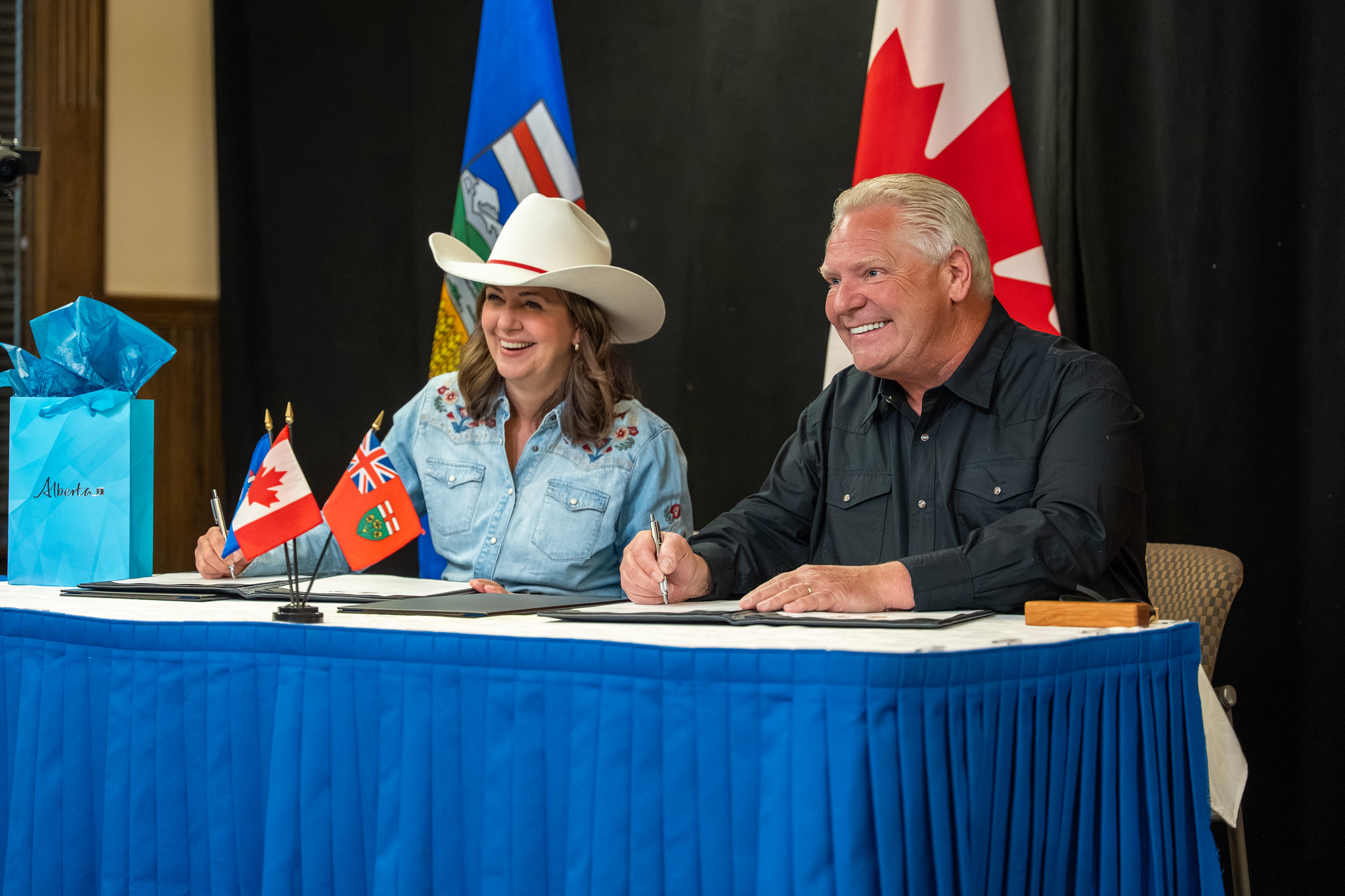
Premiers Danielle Smith and Doug Ford at a press event June 7. Commuter cycling has become a culture war issue for the conservative base in both Alberta and Ontario. Image from the Government of Alberta Newsroom flickr
Ontario Premier Doug Ford passed a bill last November to tear out $27 million dollars of completed bike lanes in Toronto citing the issue of congestion. The city says doing this could cost taxpayers $48 million, and residents have launched legal challenges. Recently Alberta’s Transportation Minister has called for Edmonton to cancel ongoing bike lane projects which he characterized as reducing vehicle capacity—a move that would similarly come at a cost to Edmonton tax payers. In both cases, it’s a jurisdictional overreach—transportation infrastructure is a municipal, not provincial issue.
Even closer to home, a Delton resident Jeremiah Rawling has been organizing to have the province intervene in a bike lane project in his neighbourhood. In an interview he states, “I think they sound great, but the reality is that from what I see, most people who use bike lanes are like me—able-bodied, military age males.”
We moved to Alberta Avenue eight years ago, specifically because it was one of the few areas we could afford, it’s close to downtown and we have access to regular public transport. This all made commuting to work and school much less complicated.
We’ve been a car-free household since 2009, and when bike lanes started being built by our home, we were thrilled—too often only wealthier neighbourhoods see this kind of investment. We received a leaflet from Rawling about his concerns, and though I was unable to attend his meeting, I want to offer my family’s perspective.
Like many people we are multimodal, meaning we bike, walk, take public transport, and occasionally ride-hailing services. For longer distances, we’ll fly, take trains and highway buses. However, cycling is our primary method of transport—yes, even in the winter. People choose to cycle for a myriad of reasons, and I think our family of six represents many of those.
The biggest issue is cost—we are a one-income household and making ends meet is already a challenge. Purchasing a car, paying for insurance, maintenance, parking, and dealing with skyrocketing gas prices just isn’t doable for us no matter what budget cuts we try to implement. Even with a bicycle for each of us, some of which we’ve had for over a decade, the cost of regular maintenance is negligible in comparison. Many of our neighbours are low-income—you’re not going to see many spandex-adorned cyclists with carbon-frame bikes that cost as much as a used car.
Traffic congestion is absolutely a factor. With existing bike infrastructure, it is simply faster for us to take the little ones to school, go to work, pick up groceries and run errands. This is true even when we want to head to the other side of the city to visit the science centre, or attend a birthday party. Obviously there are limitations—when we need to do a big grocery haul, we need to bring our trailers and sometimes that’s the only activity we can do that day. And things do slow down in the winter! Cycling through “brown sugar,” a mixture of sand and snow, isn’t always easy.
It may seem odd, but car-sickness also influences our cycling. All of us get violently car-sick, but the little ones have it worse. We’ve tried everything too, anti-nausea medications, wristbands, and strategies. Nothing works. It turns every car ride into torture.
Then there are the physical and emotional benefits, which are considerable. Like so many others, our work and schooling are very sedentary and it’s a real health concern. We are a busy family and don’t necessarily have time—or money—for gym memberships. Cycling regularly ensures we integrate physical activity into our routines.
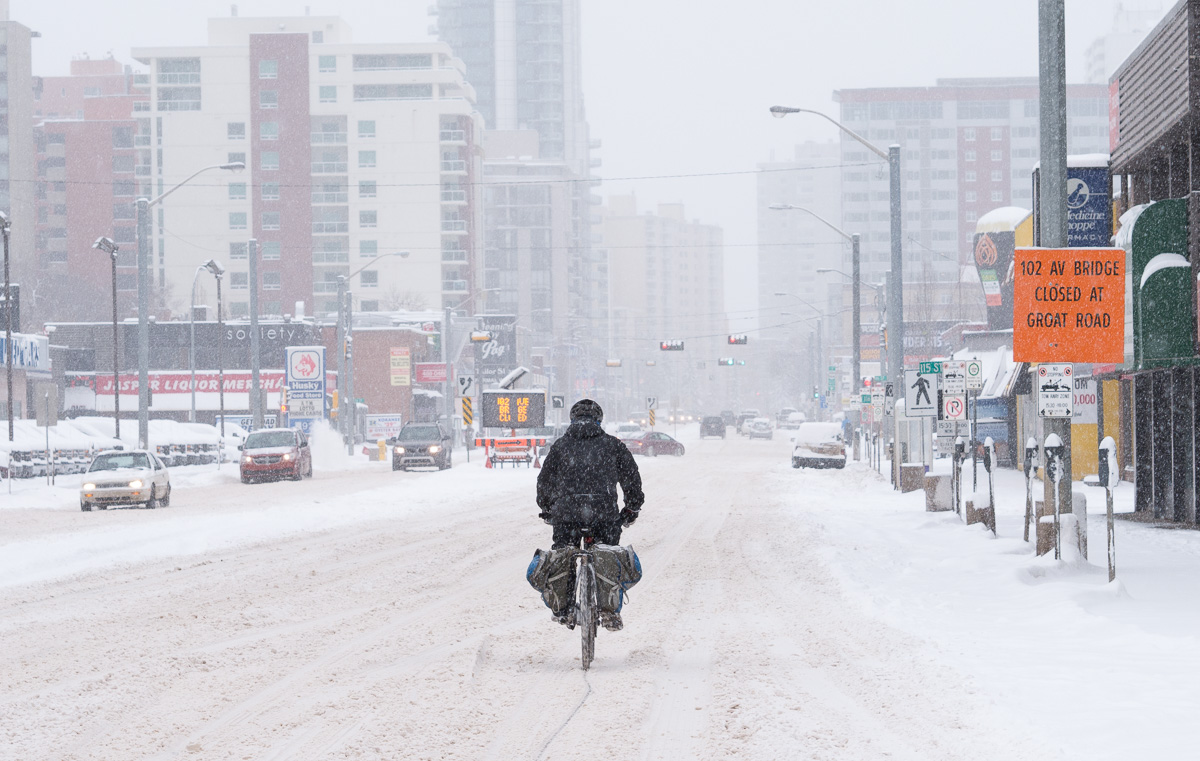
Even in winter cycling remains a very popular mode of transportation in Edmonton. Image from the More Bike Lanes Please! flickr / Creative Commons
Many of our routes take us away from major roadways, or onto paths motorized vehicles can’t access at all. We aren’t breathing in exhaust fumes or producing them, a side-benefit to cycling that is certainly worth mentioning. Edmonton really is a beautiful city, in warm weather as well as cold, and it often feels like we are out of the hustle and bustle as we move through the river valley, parks, and tree-lined side-streets. It’s enough to lift even the worst mood, and decompressing after a long day of work happens on the way home.
Not everyone has the physical ability to ride a bike, or do so all year round. Electric bikes have become much more common and make cycling more accessible to elderly and disabled riders. We share bike lanes with wheelchair and mobility scooter users on a regular basis—especially the separated lanes. When those lanes are prioritized for snow clearance in the winter, it becomes especially apparent how much more accessible our neighbourhoods have become to everyone. Where sidewalks are too often impassible, the protected bike lanes are often the only way to get around.
We too deal with various levels of able-bodiedness, from learning disabilities to physical restrictions, and our cycling methods change according to need. When our children were babies they were snuggled up in a bike trailer. When they grew out of that, they sat on the back of a cargo bike. Now they take their own bikes, and that daily exercise has worked wonders on their ability to focus in school. For myself, I struggle with a connective tissue disorder, and maintaining muscle strength is vital to my quality of life. Cycling is also much easier on our joints than walking and running, especially as my partner and I age. The cargo bike can be converted to carry aged relatives when they visit—though we’ll switch to public transport if the weather conditions are not ideal. I am considering an e-bike adaptation for the winter, because it has become increasingly difficult for me to power through the worst days.
Safety is obviously a concern for us. Though cycling infrastructure has expanded greatly in Edmonton, not all of it is equal. Our children’s bikes are too large for them to legally ride on the sidewalk—they are required to use bike lanes or the road, so we obviously worry about the danger that can put them in. We feel most secure on the protected bike paths and off-street shared pathways, and appreciate the fact that cycling infrastructure tends to keep us away from major roadways. Intersections with bike sensors and traffic lights help immensely. But even our regular school route has sections of bike lane that are just lines painted on the street, and other places force us to ride on the shoulder of a road with no lane. We use high visibility vests and tape on the bikes and our helmets, but it can get scary sometimes riding alongside cars and trucks.
I think there is a tendency to overstate the impact bike lanes have on congestion, as well as a tendency to underestimate just how many people use bike lanes. Generally people who feel the bike lanes are underused are not counting usage—their judgement is based on a quick glance. Bike lanes are less likely to experience congestion as flow remains constant, so they can seem less packed than car lanes. But cycling more than doubled in this city between 2005—2015, before protected bike lanes were built in central areas. The Downtown Bike Network sees the heaviest traffic, logging 6,501 daily trips in 2018. There are some routes we avoid because they simply have too many cyclists and when we travel as a family we can be annoyingly slow.
We don’t want to be in competition with motorized vehicles, and we aren’t asking to make congestion worse. We also aren’t suggesting that everyone needs to go car-free and hop on a bike! Cycling and other modes of transport need investment to expand and become more accessible—and safe—to help reduce that congestion. I think most motorists can agree that driving in Edmonton can often be stressful and complicated, especially when trying to navigate parking in certain areas. Dealing with this issue is going to require working with all stakeholders to get traffic flowing as easily and safely as possible, especially as this city experiences a population boom. We don’t need the province to step in and meddle in municipal affairs—as neighbours let’s keep this conversation going.
Chelsea Vowel is a parent, author, freelance writer, and public speaker living in amiskwacîwâskahikan, otherwise known as Edmonton, Alberta. She is presently developing a Cree language course for learners of all levels. You can follow Chelsea’s work at apihtawikosisan.com.